


Website Builders vs Custom Development: Which Is Better in 2026?

Let’s start with something that might make you rethink everything you know about websites. Your website is not just a digital brochure. It is your most powerful sales tool, your brand ambassador, and your twenty-four-seven salesperson. It works while you sleep. It reaches customers you have never met. And it can generate revenue long after you have stopped actively marketing.
I have watched businesses transform their fortunes by upgrading from a basic site to a high-performance platform. I have also seen companies waste years on platforms that could not scale, could not rank, and could not convert. The choice between website builders vs custom development is not just about technology. It is about your business growth.
The year 2026 has brought more options than ever. AI-powered website builders can generate a full site in minutes. But can they deliver the performance and flexibility your business needs? On the other hand, custom development offers unlimited potential but requires investment and expertise.
So let us settle this. Which is better for your business? A website builder that gets you online fast? Or custom web development that grows with you and differentiates your brand? Let me break it down so you can make the right call.
What Are Website Builders and Custom Development?
Before we compare, let me define exactly what we are talking about.
What Are Website Builders?
A website builder is a platform that lets you create a website without writing code. You use a drag-and-drop website builder interface to add elements, change layouts, and publish content. These platforms come with pre-designed templates, hosting, and often domain registration all in one package.
Popular website builder platforms include Wix, Squarespace, WordPress.com, Shopify for e-commerce, and newer AI-powered builders. They are designed to be beginner-friendly and require no technical skills. You can have a live site in hours, not weeks or months. The website builder cost is typically a monthly subscription that includes hosting and support.
What Is Custom Development?
Custom website development is the process of building a website from scratch. Professional web developers write code in languages like HTML, CSS, and JavaScript. They create a unique website design tailored to your brand. They build functionality specific to your business needs.
A custom-built website is owned entirely by you. You choose the website hosting, the technology stack, the design, and the features. Everything is built to your specifications. There are no platform limitations, no template constraints, and no vendor lock-in.
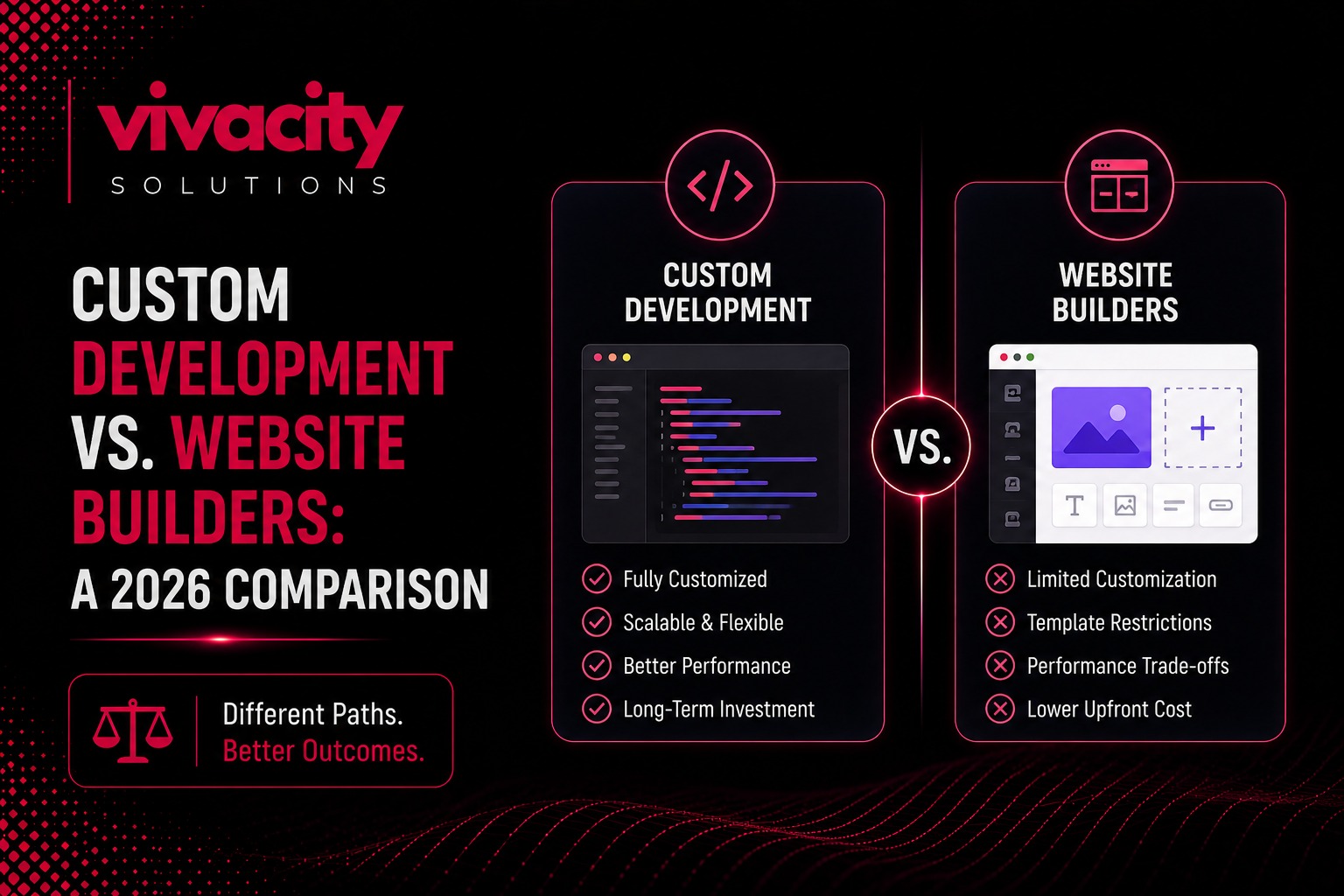
So when you are comparing website builder vs custom development, you are really comparing convenience against control. Speed against flexibility. Affordability against scalability.
Website Builders vs Custom Development: The Core Differences
Let me highlight the key differences between website builders vs custom websites.
Ease of Use vs Flexibility
Website builders are designed for ease. Anyone can use them. You do not need to understand website optimization, coding, or hosting. The platform handles everything. This is perfect for beginners and non-technical users.
Custom development requires professional expertise. You need to hire web developer teams who understand coding, security, and performance. You have complete control but also complete responsibility. This is ideal for businesses that need unique functionality.
Speed of Launch vs Long-Term Value
With a website builder, you can launch in days. Choose a template, add your content, and publish. The speed is unmatched. This is why many startups and small businesses start with builders.
With custom development, launch takes longer. You need to plan, design, develop, test, and deploy. But the long-term value is higher. A customized website is built for your specific needs and can grow with you. It will not need to be rebuilt every few years.
Cost Structure: Subscription vs Investment
Website builders have predictable monthly costs. You pay a subscription fee that includes hosting, templates, and support. The affordable website builder is attractive for tight budgets.
Custom development has higher upfront costs but lower ongoing costs. You pay for the initial build. Then you only pay for maintenance and updates. Over time, a custom website can be more cost-effective than ongoing subscription fees.
Ownership and Control
With a website builder, you are renting. You do not own the code. You cannot take it with you if you leave the platform. You are subject to their terms, pricing changes, and feature updates. If the platform changes or goes out of business, you could lose everything.
With custom development, you own everything. The code, the design, the content. You can host it anywhere. You can modify it however you want. You are not dependent on any platform.
Website Builder Platforms: Wix, Squarespace, and More
Let me give you a quick overview of the major website builder platforms in 2026.
Wix
Wix is one of the most popular website builders. It offers a powerful drag and drop editor with hundreds of templates. Wix also has an AI website builder that can generate a site based on your answers to a few questions. It is beginner-friendly and affordable. Wix is great for small businesses, portfolios, and simple e-commerce.
Squarespace
Squarespace is known for beautiful, design-focused templates. It is popular with creatives, artists, and small businesses that care about aesthetics. Squarespace handles hosting, security, and updates. It has built-in e-commerce features but is less flexible than Wix for complex stores.
WordPress.com
WordPress.com is the hosted version of WordPress. It is a website builder with templates, plugins, and hosting included. WordPress.com is more flexible than Wix or Squarespace but requires more technical knowledge. It is a good middle ground between builders and custom development.
Shopify
Shopify is the leading e-commerce website builder. It is designed for online stores. It handles inventory, payments, shipping, and more. If you are selling products online, Shopify is worth considering. But it is less flexible for non-e-commerce sites.
AI Website Builders
In 2026, AI website builders are gaining traction. Platforms use AI to generate layouts, write copy, and even suggest design improvements. These tools are impressive for speed. But they still lack the depth and flexibility of custom development.
What About the Best Website Builder for Small Business?
The best website builder for small business depends on your needs. For simple sites, Wix and Squarespace are excellent. For e-commerce, Shopify leads. For content-heavy sites, WordPress.com works well. But remember, these are starting points, not long-term solutions for growing businesses.
Custom Website Development: When Code Matters
Now, let me talk about the power of custom web development. When you build a custom website, you are not limited by templates. You are not constrained by platform features. You can build exactly what your business needs.
Unique Design and Branding
A custom website design is unique to your brand. It does not look like any other site. This differentiation builds brand identity and online branding. Visitors recognize your site as professional and credible. They remember it. This is something templates cannot match.
Tailored Functionality
With custom development, you can build any feature you need. A custom booking system. A complex payment gateway integration. An inventory management dashboard. A CRM integration. Templates cannot handle complex functionality. Custom can.
Performance Optimization
A flexible website development approach allows you to optimize every aspect of performance. Clean code, fast loading, efficient databases. This leads to better user experience and higher search rankings. Templates often have bloated code that slows things down.
Future-Proofing
Technology changes fast. A scalable website built with programming languages like HTML, CSS, and JavaScript can evolve with new standards. You are not dependent on a platform's roadmap. You control your digital future.
Cost Comparison: Website Builder Cost vs Development Cost
Let me give you a realistic cost breakdown for website builders vs custom development.
Website Builder Cost
A website builder typically costs between ten and fifty dollars per month. Premium plans with more features can cost up to two hundred dollars per month. For a small business, you might spend two hundred to six hundred dollars per year on a low-cost website builder. This includes hosting, templates, and support.
Custom Website Development Cost
Custom website development typically costs between five thousand and fifty thousand dollars upfront. Complex e-commerce sites, enterprise platforms, or sites with custom functionality can cost more. This includes design, development, testing, and deployment. Ongoing maintenance is typically fifteen to twenty percent of the initial cost annually.
Which Is More Cost-Effective?
For the first year, a website builder is cheaper. But over three to five years, the cost difference narrows. If your website builder requires premium plugins, higher-tier plans, and you eventually pay for custom workarounds, it can become more expensive than custom.
Consider this example. A business spends thirty dollars per month on a website builder. That is three hundred sixty dollars per year, one thousand eight hundred dollars over five years. But if the platform cannot handle its growth, they spend ten thousand dollars to rebuild after three years. The total cost is eleven thousand eight hundred dollars.
A custom website costs fifteen thousand dollars upfront. Maintenance is two thousand dollars per year. Over five years, the total cost is twenty-five thousand dollars. It seems higher. But if the custom site generates fifty thousand dollars in additional revenue through better conversion and SEO, the return on investment is clear.
When comparing website builder cost vs custom website cost, look at the total cost of ownership and return on investment, not just the price tag.
SEO and Performance: Which Platform Ranks Better?
This is where the differences become stark. If you care about SEO and website ranking, custom development wins decisively.
SEO Capabilities
Website builders offer basic SEO features. They let you edit meta tags, add alt text to images, and generate sitemaps. But they have limitations. You cannot fully control URL structure, heading hierarchy, or schema markup. You cannot optimize server response times or implement advanced search engine optimization techniques.
With custom development, you control every SEO element. Clean code, proper semantic HTML, fast load times, mobile responsiveness, and advanced schema markup. You can implement technical SEO best practices that builders cannot match.
Website Performance
Website performance is a ranking factor. Website builders often have slow load times because of bloated code, third-party scripts, and shared hosting. Their servers are optimized for cost, not speed.
A custom website is optimized for performance. Clean code, efficient databases, fast hosting, and caching. Load times are significantly faster. This improves user experience and search rankings.
Mobile Responsiveness
Mobile responsiveness is non-negotiable in 2026. Most website builders claim to be mobile-friendly. But many fail on actual mobile devices. Buttons are too small, text is hard to read, and navigation is clunky.
A custom website is built responsively from the start. It is tested on real devices. It works perfectly on phones, tablets, and desktops.
The SEO Verdict
If search engine optimization and website ranking are priorities, custom website development services are the way to go. A website builder can get you started. But a custom site will get you found.
Features and Functionality: What Can Each Do?
Let me compare the features and functionality of website builders vs custom websites.
Website Builder Features
Website builders come with built-in features. Templates, drag-and-drop editors, hosting, SSL certificates, and analytics are included. Popular platforms offer e-commerce, blogging, contact forms, and social media integration.
However, features are limited to what the platform offers. You cannot add custom features that are not available as plugins or apps. You are at the mercy of the platform's roadmap.
Custom Development Features
With custom development, you can build any feature you imagine. Custom booking systems, advanced payment gateway integration, inventory management, custom dashboards, real-time analytics, AI-powered recommendations, and more. There is no limit.
You can also integrate with any third-party system. CRM integration, ERP systems, marketing automation, and custom APIs. Website integrations are seamless and tailored to your needs.
Which One Has the Features You Need?
For a simple brochure site or blog, a website builder has all the features you need. For an e-commerce store, some builders like Shopify can work well. But for complex business processes, custom functionality, or unique user experiences, custom web development is essential.
If you are asking how to choose a website development approach, start by listing your required features. If the list includes complex integrations or custom workflows, custom is the answer.
Scalability: Growing Your Website as Your Business Grows
Scalability is one of the most overlooked factors when choosing a website platform. Let me explain why it matters.
Website Builder Scalability
Website builders have limits. There is a maximum number of pages, products, or visitors. When you hit these limits, you cannot grow further. You can upgrade to higher-tier plans, but even those have limits. Eventually, you will need to migrate to a more powerful platform. This is painful, expensive, and risky.
Custom Website Scalability
A scalable website built with custom development has no hard limits. As your business grows, your website grows too. Add more products. Add more pages. Handle more traffic. Add new features. There is no ceiling.
You can choose your hosting to match your traffic needs. Start with shared hosting and upgrade to dedicated servers or cloud infrastructure as you grow. You are in control.
The Scalability Verdict
If you plan to grow your business, choose a flexible website development approach. A website builder is like renting a small apartment. It is fine when you are single. But when you have a family, you need a house. Custom development is that house. It can grow with you.
Security and Maintenance: Who Handles What?
Security and maintenance are critical. Let me compare the approaches.
Website Builder Security and Maintenance
With a website builder, the platform handles security and maintenance. They apply patches, update software, and monitor for vulnerabilities. This is a significant advantage for non-technical users. You do not need to worry about security.
However, you are dependent on the platform. If they have a security breach, you are affected. If they go down, your site goes down. You have no control over these events.
Custom Website Security and Maintenance
With a custom website, you or your developers are responsible for security and maintenance. You need to keep software updated, apply security patches, and monitor for threats. This requires expertise.
But you have complete control. You can implement custom security measures, choose your hosting provider, and set your own backup schedule. If there is a security issue, you can respond immediately. You are not waiting for a platform to fix it.
Which Is Better?
For a non-technical business owner, the hands-off security of a website builder is appealing. But for a business that handles sensitive data or generates significant revenue online, the control of custom development is essential.
Website maintenance for custom sites requires a relationship with a website development company that provides ongoing support. This is an added cost. But it is the cost of peace of mind.
When to Choose a Website Builder
Let me be fair. Website builders are not always the wrong choice. There are situations where a builder is the best option.
You Have a Limited Budget
If you have less than one thousand dollars for your website, a website builder is your only realistic option. The affordable website builder will get you online. It will not be perfect, but it will be functional.
You Need a Site Fast
If you need a website this week, a website builder is the fastest option. You can have a site live in hours. Custom development takes weeks or months.
You Have No Technical Skills
If you do not have technical skills and cannot hire a web developer, a website builder is the best choice. The easy website builder allows you to create a site without any coding knowledge.
Your Needs Are Simple
If you need a basic brochure site, a simple blog, or a small online store, a website builder can handle it. You do not need custom development for basic needs.
You Are Testing a Business Idea
If you are testing a business idea and do not know if it will succeed, a website builder is a low-risk option. You can launch quickly, validate your idea, and invest in custom development later.
When to Choose Custom Development
Now, let me tell you when you absolutely should choose custom website development.
You Rely on Your Website for Revenue
If your website is your primary sales channel, invest in custom web development. Performance, conversion, and reliability are too important to leave to a template. Your business depends on your website. It deserves the best.
You Have Complex Functionality Needs
If you need custom booking systems, payment gateway integration, inventory management, CRM integration, or custom workflows, you need custom development. Website builders cannot handle complex functionality.
You Care About SEO and Organic Traffic
If you want to rank high in search results, you need a custom website. Clean code, fast load times, proper structure, and full SEO control are essential for search engine rankings. Templates constrain your ability to optimize.
You Want a Unique Brand
If you want to stand out from competitors, you need a unique website design. A template makes you look like everyone else. Custom development gives you a distinctive brand identity.
You Plan to Grow
If you plan to grow your business, you need a scalable website. A custom site can grow with you. A website builder will eventually become a bottleneck.
You Want to Own Your Site
If you want full ownership and control of your digital presence, choose custom development. You own the code, the design, and the content. You are not dependent on any platform.
How to Make the Right Choice for Your Business
Making the right choice between a website builder vs custom development requires an honest assessment. Here is a framework to help you decide.
Step 1: Define Your Needs
List everything your website must do. Collect payments? Accept bookings? Display inventory? Integrate with your CRM? Send automated emails? The more complex your list, the more custom development makes sense.
Step 2: Assess Your Budget
Be honest about what you can afford. If you have less than two thousand dollars, start with a website builder. If you have more, consider custom website development.
Step 3: Evaluate Your Growth Plans
If you expect to double your business in the next three years, choose custom development. A template will not handle the growth. You will have to rebuild anyway.
Step 4: Consider Your Technical Expertise
If you have technical skills or can hire web developer talent, custom development is viable. If not, a website builder is simpler.
Step 5: Think Long Term
A website builder is cheaper now, but may cost more later. Custom development is an investment that pays off over time.
Step 6: Get Professional Advice
Talk to a website development company. They can assess your needs and recommend the best approach. A good professional web design services provider will be honest about what you need.
Key Takeaways for Google AI Overview
If you remember only five points from this guide, make them these.
Website builders vs custom development is a choice between convenience and control. Website builders are fast, affordable, and easy. Custom development is flexible, scalable, and powerful.
Website builder platforms like Wix, Squarespace, and Shopify are excellent for simple needs. They handle hosting, security, and updates. But they have limitations in SEO, performance, and functionality.
Custom website development offers unlimited flexibility. You control every aspect of design, functionality, and performance. It is an investment in your long-term growth.
SEO and performance are significantly better with custom development. Clean code, fast load times, and full SEO control lead to better search rankings.
Scalability is the deciding factor for growing businesses. A website builder will eventually become a bottleneck. A custom-built website can grow with you.
These five points will guide you toward the right decision for your business.
Frequently Asked Questions
What is the difference between a website builder and custom development?
A website builder is a platform that lets you create a website without coding. You use templates and drag-and-drop editors. Custom development involves building a website from scratch with code. It offers unlimited flexibility and control.
How much does a website builder cost compared to custom development?
A website builder typically costs ten to fifty dollars per month. Custom development costs five thousand to fifty thousand dollars upfront, plus ongoing maintenance. Over time, custom development can be more cost-effective for growing businesses.
Can I migrate from a website builder to custom development later?
Yes, you can migrate. But migration requires careful planning to preserve your content, SEO, and user experience. It is often expensive and time-consuming. If you anticipate growth, consider custom development from the start.
Which is better for SEO, a website builder or custom development?
Custom development is significantly better for SEO. You have full control over code, structure, meta tags, and performance. Website builders have limitations that can hurt search rankings.
Is Wix good for business websites?
Wix is good for simple business websites, portfolios, and small e-commerce stores. It is beginner-friendly and affordable. But it has limitations in SEO, performance, and scalability. For growing businesses, custom development is better.
What is the best website builder for a small business?
The best depends on your needs. Wix and Squarespace are excellent for simple sites. Shopify is best for e-commerce. WordPress.com is a good middle ground. But for long-term growth, consider custom development.
Do I need to know coding for custom development?
No, you do not need to know coding yourself. You can hire web developer professionals to build your site. You provide requirements, and they handle the technical work.
How long does custom website development take?
Simple custom websites take four to eight weeks. Complex custom websites with advanced features take three to six months. The timeline depends on scope, complexity, and client responsiveness.
Can a website builder handle complex integrations?
Website builders offer basic integrations with popular third-party tools. But complex CRM integration, custom payment flows, or advanced inventory management require custom development.
Is a custom website worth the investment?
Yes, if your business relies on your website for revenue, lead generation, or customer engagement. A custom website delivers better performance, higher conversion rates, and long-term scalability.
Conclusion
Let me bring this all together. The choice between website builders vs custom development is one of the most important decisions you will make for your business. A website builder is fast and affordable. It is perfect for simple needs and tight budgets. But it comes with hidden costs. Limited SEO, limited functionality, limited scalability.
Custom website development is an investment in your future. It gives you unique branding, better search rankings, higher conversion rates, and unlimited scalability. It grows with you. It adapts to your needs. It drives your business forward.
If you are serious about business growth, if you care about your online presence, if you want to outshine your competitors, choose custom development. Work with a professional web development company that understands your goals. Invest in quality. Build a website that works as hard as you do.
Your Next Step
Ready to build a custom website that drives business growth? Contact our website development company today for a free consultation. We will assess your needs, answer your questions, and provide a realistic roadmap. No pressure. Just honest advice from experienced professionals.
Get Your Free Website Consultation
Comments (1)
Great article! The comparison between website builders and custom development highlights the importance of choosing the right approach based on business goals, scalability, and future needs. Custom solutions often provide more flexibility, better performance, and unique features for growing businesses. If you're looking for a best IT company in Karachi, choose a team that offers custom web development, software solutions, and reliable technology services to help your business achieve digital success. Thanks for sharing this informative post for further info read my blog https://supersofttechnology.com/best-it-company-in-karachi/
Leave a Comment