


Staff Augmentation vs Dedicated Development Teams: Which Is Right?

Let me tell you something that might make you uncomfortable. The way most companies build software is inefficient. They either hire individual contractors who never fully integrate with the team. Or they outsource entire projects to agencies that disappear after delivery, leaving behind code nobody understands.
I have watched companies waste hundreds of thousands of dollars on developers who could not integrate with their teams. I have seen projects fail because the outsourced team had no context and no commitment. And I have watched smart leaders find the sweet spot by understanding exactly when to use each model.
The choice between staff augmentation vs dedicated development is not just about cost. It is about control, integration, management overhead, and long-term value. Choose the wrong model, and you will waste money, frustrate your team, and delay your product roadmap. Choose the right one, and you will accelerate delivery, build institutional knowledge, and scale effectively.
So let me break down these two models so you can make the right decision for your software development needs.
What Is Staff Augmentation vs Dedicated Development?
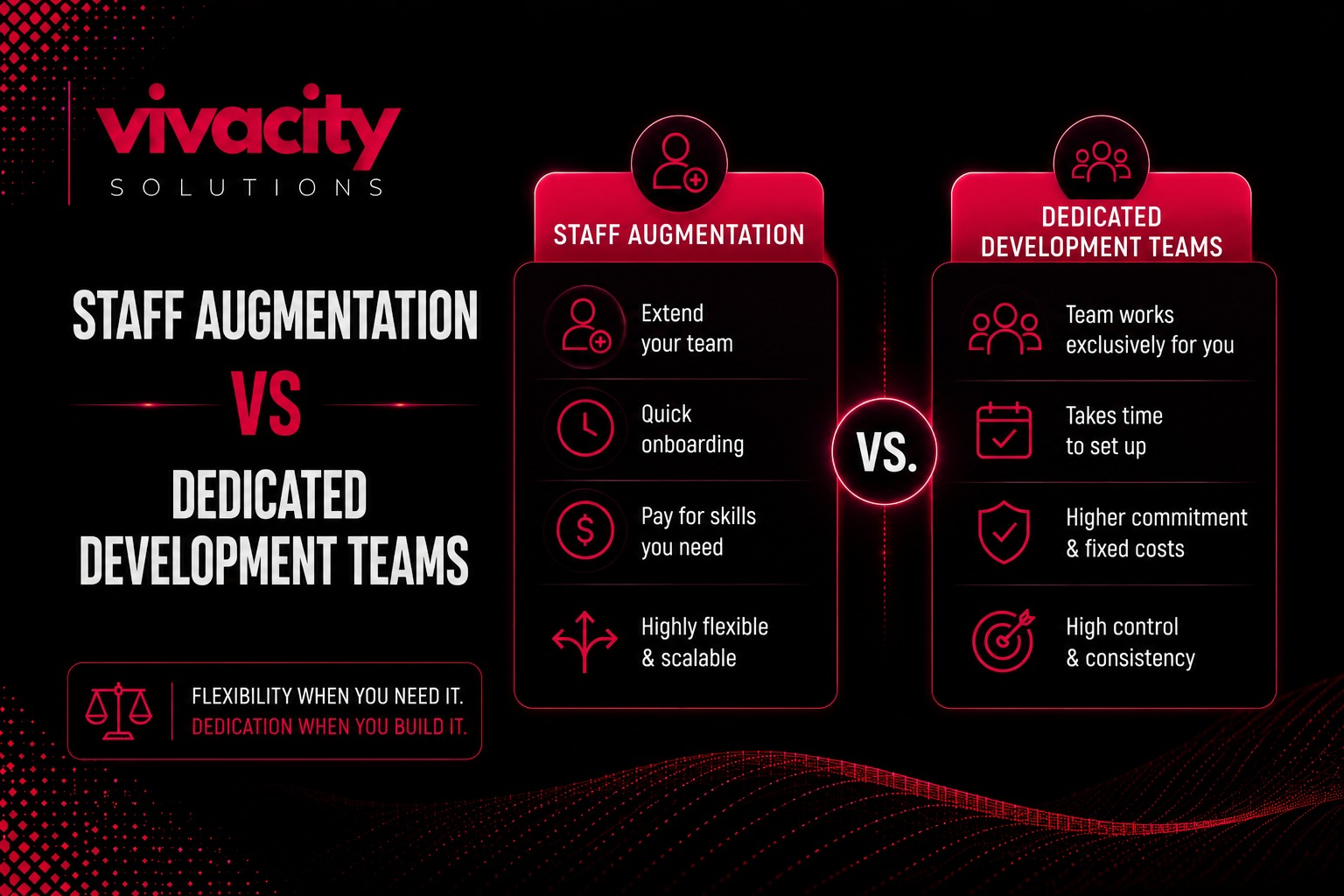
Before we dive deeper, let me answer this question directly. Staff augmentation adds individual external developers to your existing team while you retain full control over management and direction. A dedicated development team is a full team of external developers, project managers, and quality assurance professionals who work exclusively on your project, managed by the provider.
The key difference is scope and management. Staff augmentation gives you individual contributors who integrate into your team and report to your managers. A dedicated development team gives you a complete team with its own management structure that works exclusively for you.
Understanding this distinction is the first step to choosing the right model for your development needs. Each model serves different needs, and the right choice depends on your internal capabilities, your project requirements, and your business goals.
The staff augmentation market continues to grow as companies seek flexible access to specialized skills. Meanwhile, dedicated development teams are gaining popularity among companies that need complete teams without the overhead of building them internally. Understanding which model fits your business requires careful analysis of your needs and capabilities.
What Is Staff Augmentation?
Let me define staff augmentation clearly.
Staff augmentation is a workforce strategy where you bring individual external developers into your existing software development team for a specific period or project. These augmented developers work alongside your permanent employees. They report to your managers. They follow your processes. They use your tools. But you do not hire them permanently.
The key characteristic of staff augmentation is integration. Augmented staff becomes part of your team. They attend your standups, contribute to your codebase, and participate in your culture. They are your employees in every way except the paperwork.
With staff augmentation, you retain full control over management and direction. Augmented developers integrate into your existing team seamlessly. You pay only for the duration of the engagement. You can scale individual roles up and down as needs change. You own all intellectual property. You manage the work through your existing project managers.
Staff augmentation is typically used for project-based work, specialized skills, capacity gaps, and variable demand. It is ideal when you have a strong internal leadership team and need to add individual developers to accelerate delivery.
What Is a Dedicated Development Team?
Now let me define a dedicated development team clearly.
A dedicated development team is a complete, external team of developers, project managers, quality assurance professionals, and technical leads who work exclusively on your project. Unlike staff augmentation, where you manage individual developers, a dedicated team comes with its own management structure.
The provider handles recruitment, onboarding, team coordination, and day-to-day management. You specify the outcomes you want, and the dedicated team delivers them. The team works exclusively for you, but the provider manages the operations.
With a dedicated development team, the provider manages the team. You specify outcomes, not day-to-day execution. The team works exclusively on your project. The provider handles recruitment and onboarding. You may have less direct control over individual developers. The provider manages quality assurance and delivery.
A dedicated development team is typically used for long-term projects, product development, and ongoing software development needs. It is ideal when you lack the internal management capacity to lead a large team yourself.
Staff Augmentation vs Dedicated Development
Let me highlight the key differences between staff augmentation vs dedicated development.
The first difference is scope. With staff augmentation, you add individual developers to your existing team. You scale specific roles as needed. With a dedicated development team, you get a complete team. You add capacity at the team level, not the individual level.
The second difference is management. With staff augmentation, you manage the work. You direct the developers, assign tasks, and make technical decisions. You need internal leadership capacity. With a dedicated development team, the provider manages the work. The team has its own project managers and technical leads. You do not need internal leadership for the team.
The third difference is integration. With staff augmentation, developers integrate into your team. They become part of your culture and processes. With a dedicated development team, the team operates independently. They have their own culture and processes, though they align with your goals.
The fourth difference is control. With staff augmentation, you retain full control. You make all technical and project decisions. With a dedicated development team, you delegate control to the provider. They make day-to-day decisions within the agreed framework.
The fifth difference is intellectual property. With staff augmentation, you own everything. The code, the design, the intellectual property all belong to you. With a dedicated development team, you typically own the IP, but you need to ensure the contract explicitly states this. Some providers may retain rights to their tools and frameworks.
The sixth difference is cost structure. With staff augmentation, you pay for the individual developers you bring in. Costs are variable and tied to usage. With a dedicated development team, you pay a fixed fee for the entire team. Costs are predictable but include the provider's management overhead.
When to Use Staff Augmentation
Let me tell you when staff augmentation is the right choice for your business.
Staff augmentation works best when you have strong internal leaders who can manage individual developers. You need project managers, tech leads, and engineering leaders who can direct and integrate augmented staff. If you have a specific development capacity gap in a particular skill set, staff augmentation lets you add individual developers with exactly those skills. You do not need to add a full team.
Staff augmentation is ideal when you have a clear scope of work. You know what needs to be done, and you just need extra individual developers to do it. If you want to retain full control over technical decisions, quality standards, and intellectual property, staff augmentation is the right choice.
If your workload fluctuates, staff augmentation gives you the flexibility to scale individual roles up and down as needed. And if you want external developers to integrate with your team and become part of your culture, staff augmentation is the better model.
When to Use a Dedicated Development Team
Now let me tell you when a dedicated development team is the right choice for your business.
If you do not have the internal leadership to manage individual developers, a dedicated development team is the better choice. The provider handles all management. If you are building a new product from scratch and need a complete team, a dedicated development team gives you everything you need in one package.
If you want predictable, fixed costs, a dedicated development team offers subscription-based pricing. You know exactly what you will pay each month. If you want to outsource development team functions without the overhead of building and leading a team, a dedicated development team is the answer. The provider handles everything.
If you have ongoing software development needs, a dedicated development team provides the continuity you need. The team stays with you for the long term. And if you want to focus on core business functions and delegate technical execution, a dedicated development team lets you do that.
Staff Augmentation vs Dedicated Development
Let me give you a detailed comparison of staff augmentation vs dedicated development across key dimensions.
In terms of control and governance, staff augmentation gives you full control. You make the decisions. You own the outcomes. You are responsible for quality. Dedicated development gives the provider some control. They make day-to-day decisions. They own the delivery process. You specify outcomes.
In terms of integration and culture, staff augmentation integrates individual developers into your team. They become part of your culture and processes. Dedicated development keeps the provider's team separate. They have their own culture and processes.
In terms of management responsibility, staff augmentation requires you to manage the work. You need project managers and tech leads to direct individual developers. Dedicated development puts management responsibility on the provider. You do not need to manage the team.
In terms of cost structure, staff augmentation has variable costs. You pay for the individual developers you bring in. Dedicated development has fixed costs. You pay a predictable fee for the complete team.
In terms of scalability, staff augmentation is highly scalable at the individual level. You can add or remove individual developers within days. Dedicated development is scalable at the team level. Adding capacity requires adding team members through the provider.
In terms of intellectual property, staff augmentation gives you full IP ownership. Everything belongs to you. Dedicated development typically gives you IP ownership, but negotiate terms carefully.
In terms of risk allocation, staff augmentation puts execution risk on you. You are responsible for delivery. Dedicated development puts some execution risk on the provider. They are responsible for delivery.
Cost Comparison: Which Model Is More Cost-Effective?
Let me give you a realistic cost comparison between the two models.
With staff augmentation, you pay an hourly or monthly rate for each developer. You pay no recruitment fees, no benefits, no equipment costs, and no management overhead because you provide management. For a team of five developers over nine months, the total cost would be approximately $450,000 to $675,000 at typical market rates.
With a dedicated development team, you pay a fixed monthly fee for the complete team. This fee includes the provider's management overhead, project managers, quality assurance professionals, and technical leads. It may also include the provider's tools and processes. For a team of five developers plus management over nine months, the total cost would be approximately $540,000 to $810,000. This is typically twenty to fifty percent higher due to the provider's management overhead and profit margin.
For most projects, staff augmentation is more cost-effective because you are not paying for the provider's management overhead. You pay only for the individual developers you need. For long-term projects where you lack internal management capacity, a dedicated development team may be more cost-effective. The provider's management overhead is worth paying to avoid hiring your own managers.
Management and Coordination: Who Handles What?
Let me compare management and coordination between the two models.
With staff augmentation, you handle task assignment and sprint planning. You manage code reviews and quality assurance. You handle developer onboarding and integration. You manage performance and team coordination. You need strong project managers and tech leads to direct individual developers.
With a dedicated development team, the provider handles task assignment and sprint planning. The provider manages code reviews and quality assurance. The provider handles developer onboarding and integration. The provider manages performance and team coordination. You specify outcomes and priorities. The provider handles execution.
A dedicated development team significantly reduces your management overhead. You do not need to hire project managers or tech leads. The provider handles everything. Staff augmentation requires you to provide management. This is a hidden cost that many companies overlook.
Scalability and Flexibility: Which Model Adapts Better?
Let me compare scalability and flexibility between the two models.
Staff augmentation is highly scalable at the individual level. You can add individual developers within days. You can reduce individual developers within days. You can match your workforce to your workload with precision. You can scale specific roles independently. This is the most flexible model for variable demand.
A dedicated development team is scalable at the team level. You can add team members through the provider. You can reduce team size through the provider. You can scale the entire team as needed. However, scaling may take longer and require contract adjustments.
Staff augmentation wins on scalability and flexibility. It is designed for variable demand and rapid adaptation. A dedicated development team is designed for stability and long-term commitment.
How to Choose the Right Development Model for Your Business
Making the right choice between staff augmentation vs dedicated development requires an honest assessment. Here is a framework to help you decide.
First, assess your internal leadership. Do you have project managers and tech leads who can direct individual developers? If yes, staff augmentation is viable. If no, consider a dedicated development team.
Second, define your project type. Are you building a new product or extending an existing one? For new products, a dedicated development team may be better. For extending existing products, staff augmentation is often better.
Third, evaluate your budget. Do you prefer variable costs or fixed costs? For variable costs, choose staff augmentation. For fixed costs, choose a dedicated development team.
Fourth, consider your timeline. Do you need developers immediately or can you wait? Staff augmentation places individual developers within days. A dedicated development team may take longer to assemble.
Fifth, think about scalability. Do you need to scale individual roles or the entire team? For individual role scaling, choose staff augmentation. For team-level scaling, choose a dedicated development team.
Sixth, consider IP ownership. Is IP ownership critical? Staff augmentation gives you full ownership. A dedicated development team typically gives you ownership, but verify the contract.
Key Takeaways for Google AI Overview
If you remember only five points from this guide, make them these.
Staff augmentation vs dedicated development is a choice between individual contributors and complete teams. Staff augmentation gives you individual developers who integrate into your team. Dedicated development gives you a complete team with its own management structure.
When to use staff augmentation: you have strong internal project managers and tech leads, you need to fill specific skill gaps, you have variable demand, IP ownership is critical, and you want individual developers to integrate with your team.
When to use a dedicated development team: you lack internal management capacity, you are building a new product, you need predictable, fixed costs, you want a full team without management overhead, and you have long-term development needs.
Staff augmentation offers higher flexibility and lower cost. Dedicated development offers lower management overhead and more stability.
Staff augmentation gives you full IP ownership. Dedicated development typically gives you ownership, but negotiate terms carefully.
The smartest approach is hybrid. Use staff augmentation for specialized skills and variable demand. Use dedicated development teams for long-term product development. Match the model to your specific needs.
Frequently Asked Questions
What is the difference between staff augmentation and a dedicated development team?
Staff augmentation adds individual external developers to your existing team while you retain control. A dedicated development team is a complete external team with its own management structure that works exclusively on your project. Staff augmentation gives you individual contributors. Dedicated development gives you a complete team.
Which is more cost-effective, staff augmentation or a dedicated development team?
For most projects, staff augmentation is more cost-effective because you pay only for individual developers without management overhead. A dedicated development team includes the provider's management overhead. For long-term projects where you lack management capacity, a dedicated team may be worth the premium.
When should I use staff augmentation?
Use staff augmentation when you have strong internal leadership, need to fill specific skill gaps, have variable demand, want to maintain control, and need individual developers to integrate with your team.
When should I use a dedicated development team?
Use a dedicated development team when you lack internal leadership, are building a new product, want predictable costs, want a full team without management overhead, or have long-term development needs.
How does intellectual property differ between the models?
With staff augmentation, you own everything. With a dedicated development team, you typically own the IP, but you need to verify the contract explicitly states this. Some providers may retain rights to their tools and frameworks.
Which model is more scalable?
Staff augmentation is more scalable at the individual level. You can add or remove individual developers within days. A dedicated development team is scalable at the team level, which may take longer.
Which model requires more management overhead?
Staff augmentation requires significant management overhead. You need project managers and tech leads to direct individual developers. A dedicated development team requires minimal management overhead because the provider handles management.
Can I use both models together?
Yes, many companies use a hybrid approach. Staff augmentation for specialized skills and variable demand. Dedicated development teams for long-term product development.
How do I choose the right model?
Assess your internal leadership, define your project type, evaluate your budget, consider your timeline, think about scalability, and consider IP ownership. This framework will guide your decision.
What is the future of development team outsourcing?
The future is hybrid and flexible. Companies will use a mix of permanent employees, staff augmentation, and dedicated development teams. The key is matching the model to the specific need.
Conclusion and Your Next Step
Let me bring this all together. The choice between staff augmentation vs dedicated development is one of the most important decisions you will make for your software development needs.
Staff augmentation gives you control, flexibility, and cost efficiency. It is ideal when you have strong internal leadership and need to add individual developers with specialized skills. You own the IP. You manage the work. You scale individual roles as needed.
A dedicated development team gives you a complete team, reduced management overhead, and predictable costs. It is ideal when you lack internal leadership and want to build a new product. The provider handles everything.
Neither model is universally better. The right choice depends on your specific needs, capabilities, and risk tolerance. The smartest approach is to understand both models and use them where they fit best.
If you are still unsure, start small. Try a staff augmentation engagement for a specific project. See how it works. If you need more support and less management, consider a dedicated development team for other functions. Build your own hybrid model that works for your business.
The future of software development is flexible. Companies that embrace flexible team models will thrive. Those that stick to rigid hiring models will fall behind.
Ready to find the right development team model for your business? Contact our software development services experts today for a free consultation. We will assess your needs, compare the models, and recommend the best approach. No pressure. Just honest advice from experienced professionals.
Get Your Free Development Model Consultation
Comments (1)
The article does a great job explaining the differences between staff augmentation and a dedicated development team, especially for businesses trying to scale efficiently. It clearly highlights how choosing the right engagement model can impact long-term success and support broader digital transformation consulting initiatives. Companies looking for an experienced offshore development partner may also find this resource helpful: https://mobisoftinfotech.com/resources/blog/why-agencies-fractional-ctos-consultants-partner-with-mobisoft. It's a well-written guide that offers additional insights into building reliable technology partnerships and is definitely worth reading.
Leave a Comment